
Show Notes:
In this episode, we unpack a big misconception in ACL rehab: the belief that if PT feels hard, it must be working. We break down why sweat, fatigue, and high heart rates don’t automatically equal progress, especially when your knee is swollen or stiff the next day. We dive into the difference between capacity and tolerance, explain why excessive plyometric volume can quietly stall recovery, and outline what intentional, criteria-driven rehab actually looks like. If you’ve ever walked out of a session exhausted but unsure if you’re truly moving forward, this episode will help you rethink what “good rehab” really means.
What is up team? And welcome back to another episode on the ACL Athlete Podcast. Let me ask you something: if your PT session leaves you drenched in sweat, your heart rate elevated, your legs shaking and fatigued, does that automatically mean it was a good session? This is something I hear all the time. “How’s rehab going?” “It’s hard.” And then the response is, “Oh, good, that means it’s working, right?” But that assumption deserves a closer look.
When I dig deeper—especially when ACLers reach out asking for more help or guidance beyond what they’re getting in person—I start to hear more details. They tell me they’re doing a lot of jumping, sweating for 30, 45, maybe even 60 minutes straight. The sessions feel intense and demanding. But then I hear, “My knee was kind of puffy the next day,” or “It was still aching and tight again.” The knee is still having issues, even though the workout felt really hard.
One thing I want to make clear is this: PT being hard does not automatically mean PT is good. We’ve been conditioned to believe that sweat equals effort, effort equals progress, and exhaustion equals growth. That might apply in conditioning contexts. But it does not automatically apply to rehab—especially ACL rehab. Rehab is not about who can survive the hardest workouts.
Rehab is about applying the right stress, at the right time, in the right amount. Anyone, to be completely honest, can make you tired. Very few people can dose load correctly. I could give you 50 burpees for time and make you sweat, question your life choices, and feel completely crushed. But that doesn’t mean it’s targeted or productive—especially if your knee isn’t responding well to load.
Let’s talk about something common. You’re six or maybe twelve months out from surgery, and you’re cleared to jump, or jumping is now incorporated into your ACL rehab. What often happens next is that sessions become heavy on jumping—continuous plyometrics, higher volume, minimal rest. You’re sweaty and gassed, and in the moment, your knee might feel okay. You’re not feeling a ton of discomfort or symptoms right then.
But your knee doesn’t care how hard you worked. It cares how much load it can absorb relative to its current capacity—how much tolerance it has. Every landing is a force. Every deceleration is a force. Every contact increases the quad and knee demand and places stress through that joint. If the volume exceeds what your knee currently tolerates, it’s going to talk back to you—sometimes not during the session, but after.
That response may show up as swelling, stiffness, loss of extension or flexion, or just a general feeling that something is off. You might feel like you took a step backward. That’s not weakness, and it’s not a lack of toughness. It’s often a dosage issue. The load exceeded your tolerance.
Here’s the framework I want you to remember. Capacity is what your tissues can handle—the amount of load you can tolerate in a moment. Tolerance is how your knee responds in the next 24 to 48 hours. If your knee is puffy, more painful, stiffer, or performs worse in the next session, then you likely exceeded that tolerance. The worst thing you can do is say, “Well, it was hard, so it must be good.”
Hard is not the metric. The stimulus and the adaptation are the metrics. We want to change something specific—strength, power, symmetry, performance—while managing symptoms and recovery. Intentional ACL rehab looks different. It means tracking volume, managing ground contacts, assessing strength levels, and continuing to measure performance—especially vertical and horizontal outputs.
It also means monitoring how the knee responds to impact and building recovery days into the plan. I’ve talked about the high-low approach, which is foundational in programming. Balancing stress and recovery, while monitoring swelling and pain, is critical. We assess, prescribe, observe the response, and then adjust. We don’t just repeat hard workouts and hope the knee doesn’t flare up.
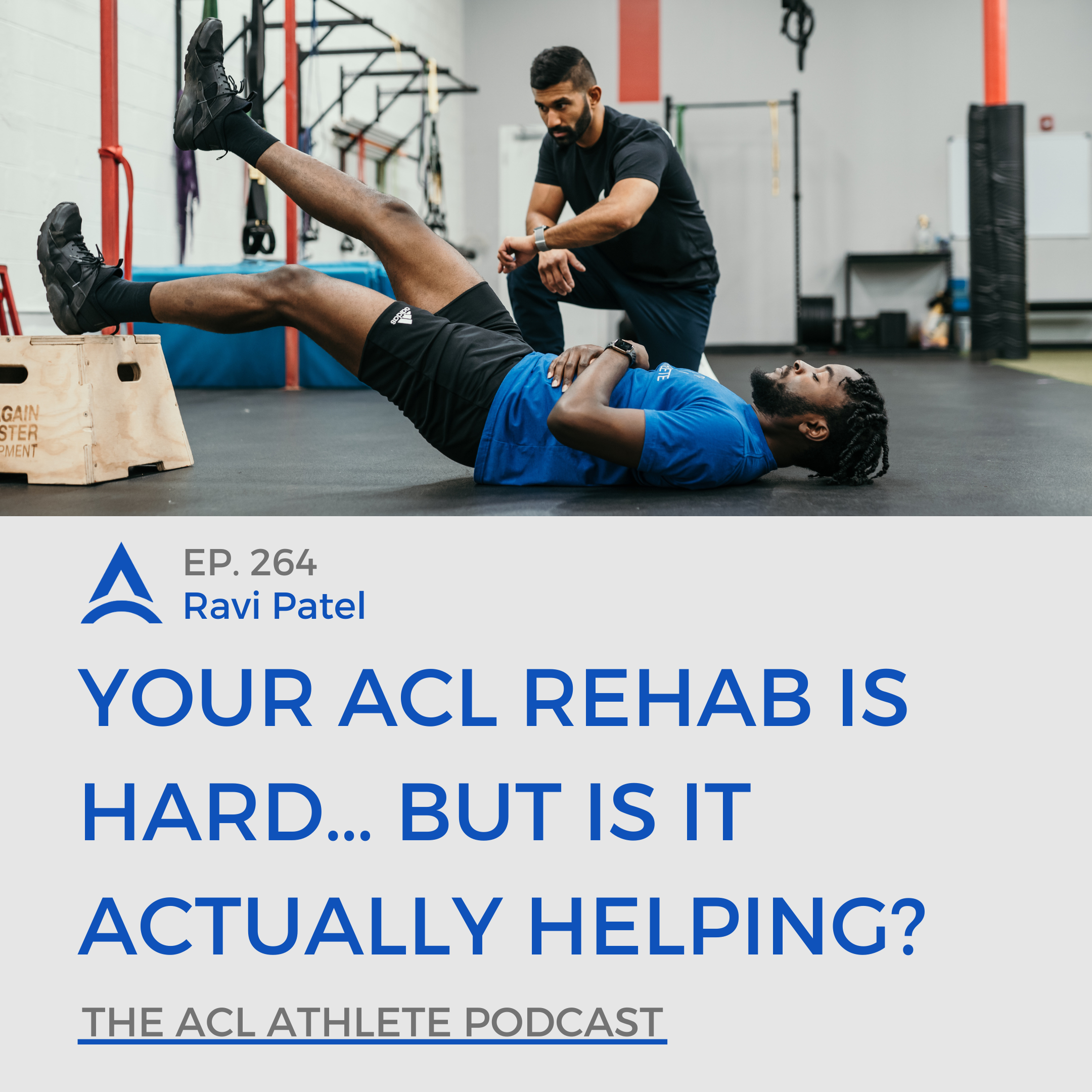
You can and should train hard in ACL rehab. But it must be precise, prescriptive, and targeted—not random. What I often see is athletes flaring up after hard sessions or working around deficits rather than addressing them. For example, doing a ton of box jumps isn’t the same as true plyometrics. A box jump is part of a jumping cycle, but it doesn’t involve a true stretch-shortening cycle like reactive plyometrics do.
If you’re an athlete listening, pay attention to how your knee responds the next day. That feedback is not failure. It’s not a sign that you’re not tough enough. It’s information. If you’re a parent listening and your kid says PT is hard, ask better questions: Is it progressing? Is swelling being monitored? Is volume being adjusted? Is there a clear plan?
Hard workouts are easy to create. Smart rehab is much harder to design. ACL rehab requires careful dosing, recovery balance, and a strong dose-response relationship. We cannot mistake “hard” for “quality.” We need to consistently test what matters—quad strength, hamstring strength, power development, jumping ability, range of motion, swelling, and pain profile.
Programming must be structured with intention. The weekly layout, the balance between high and low days, and the alignment with your rehab stage all matter. That structure supports recovery and drives adaptation. Yes, we want athletes sweating and fatigued at times. But it must meet them where they are in terms of capacity, tolerance, and goals—not just beat them up for the sake of intensity.
I’ve seen this mindset before, even outside of ACL rehab. Coaches sometimes believe running athletes into the ground builds conditioning. While intensity has a place, physiology and sound strength and conditioning principles matter. Rehab principles matter. Progression must be specific, measured, and aligned with performance goals.
We want you challenged. We want you to push. But it must match your stage, strength levels, performance targets, and ability to recover. Anyone can make sessions hard. Very few can make them precise. Precision is what ultimately gets you back.
There is a flip side to this, too. If you feel like you’re going too slow, that matters as well. The key is individualization. We base programming on testing, and we continue testing throughout the process. Sometimes we intentionally “undercook” the stimulus first, then gradually nudge it forward to find the right dose-response relationship.
This becomes even more important in the mid to late stages of ACL rehab, when running, jumping, and cutting introduce more variables and greater joint stress. The total load through the knee increases, and dosage becomes even more critical. Managing that complexity requires intention and ongoing assessment. That’s how we continue to move the needle.
So as you reflect on your sessions, ask yourself: Is it hard and targeted, or just hard? What exactly am I working on? How does this align with my long-term goals? How does it connect to the criteria I need to meet to return to sport at my highest level while reducing the risk of reinjury?
I hope this helps you look at your ACL rehab with more clarity and discernment. If you have any questions, please reach out. This is your host, Ravi Patel, signing off.
Subscribe and leave The ACL Podcast a review – this helps us spread the word and continue to reach more ACLers, healthcare professionals, and more. The goal is to redefine ACL rehab and elevate the standard of care.
Resources:
- Check out our free ebooks on our Resources page
- Sign up for The ACL Athlete – VALUE Newsletter – an exclusive newsletter packed with value – ACL advice, go-to exercises, ACL research reviews, athlete wins, frameworks we use, mindset coaching, blog articles, podcast episodes, and pre-launch access to some exciting projects we have lined up
- 1-on-1 Remote ACL Coaching – Objective testing. An individualized game plan. Endless support and guidance. From anywhere in the world.
- More podcasts? Check out our archives
Connect:
- Have questions or a podcast idea? Send us a message