Show Notes:
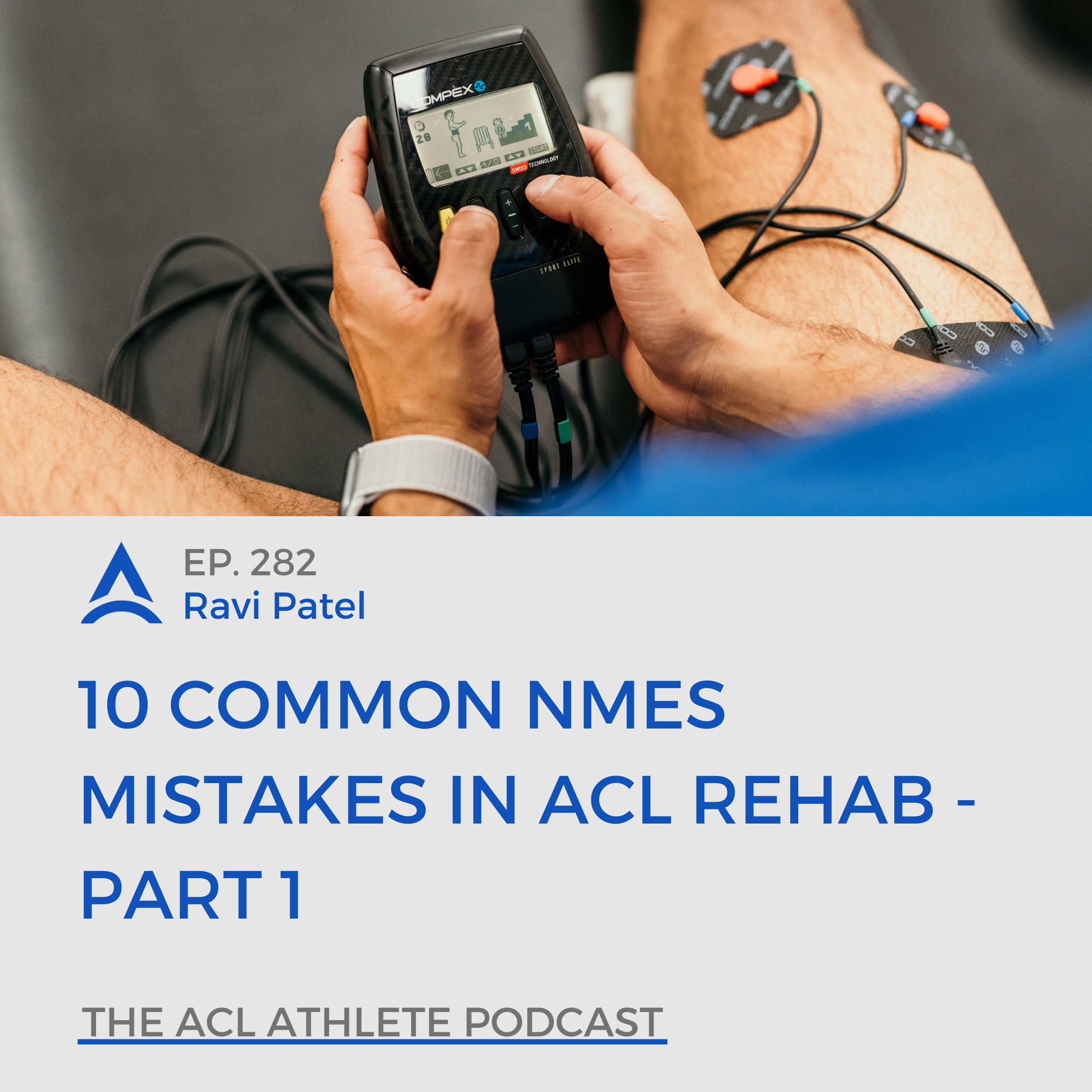
In this episode, we kick off a two-part series on one of the most valuable tools in ACL rehab: neuromuscular electrical stimulation, or NMES. We break down why arthrogenic muscle inhibition makes quad recovery so much harder than most athletes expect, why stopping NMES the moment the quad starts firing is one of the most common and costly mistakes we see, and how a simple shift in frequency and intensity can produce up to seven times more stimulus than a standard in-person PT session alone. We also cover the difference between a TENS unit and an NMES unit, what max tolerable intensity actually means in practice, and when to reintroduce NMES if quad strength has plateaued deep into recovery. Whether you are an ACL athlete, a clinician, a parent supporting someone through this process, or a coach working with post-op athletes, this episode gives you the knowledge to ask better questions and get more out of every session.
NMES Device:
Motor Points for the Quads
- Motor point heatmap guide for neuromuscular electrical stimulation of the quadriceps muscle
- Muscle motor point identification is essential for optimizing neuromuscular electrical stimulation use
NMES Research
- Neuromuscular electrical stimulation is effective in strengthening the quadriceps muscle after anterior cruciate ligament surgery – Hauger 2018
- Effects of Neuromuscular Electrical Stimulation After Anterior Cruciate Ligament Reconstruction on Quadriceps Strength, Function, and Patient-Oriented Outcomes : A Systematic Review – Kim 2010
- Utility of Neuromuscular Electrical Stimulation to Preserve Quadriceps Muscle Fiber Size and Contractility After Anterior Cruciate Ligament Injuries and Reconstruction: A Randomized, Sham-Controlled, Blinded Trial – Toth 2020
- Can the Use of Neuromuscular Electrical Stimulation Be Improved to Optimize Quadriceps Strengthening? – Glaviano 2015
- Who’s Afraid of Electrical Stimulation? Let’s Revisit the Application of NMES at the Knee – Arhos 2024
What is up team and welcome back to another episode on the ACL Athlete Podcast. Today, we are kicking off a two-part series on one of my favorite tools in ACL rehab—that is, NMES, or neuromuscular electrical stimulation. This is something I’ve talked about in previous podcast episodes, including some of the earlier ones where I covered the research, specific parameters, and even some device considerations. You can easily search our website or podcast for NMES and those episodes will come up.
But today, I want to revisit NMES from a different angle—what I’ve observed in practice, common mistakes I see, and what actually seems to work best based on both research and real-world application. The goal is to help you squeeze every bit of value out of this tool. Whether you’re an ACLer, a clinician, a parent supporting an athlete, or just someone navigating rehab, there’s a lot we can optimize here for quad recovery.
What still surprises me—even after all these years—is how often NMES is not being used at all. I still talk to people every single week who say, “Yeah, I don’t know what that is,” or “We used it for a couple of weeks and then stopped.” Or their PT says, “Your quad is firing now, so we don’t need it anymore.” Context matters, but there’s a bigger principle here. Just because the quad starts visibly activating does not mean we’re done with NMES.
Across these two episodes, we’re going to break down 10 of the most common NMES mistakes I see athletes—and clinicians—make. In today’s episode (part one), we’ll focus on the big-picture issues: whether you’re using it correctly, when you’re using it, how often, and intensity. Then in part two next week, we’ll go deeper into setup and execution details—pad placement, size, duty cycles, skin contact, batteries, and other technical parameters that really fine-tune the outcome.
Before we get into the mistakes, I want to make something very clear, because it’s part of why this series exists. NMES should be the standard of care for almost every postoperative knee case. That includes ACL reconstructions, meniscus procedures, quad tendon or patellar tendon repairs, and even total knee replacements. Any situation where the quadriceps are inhibited—especially when swelling and pain are present—NMES has a role. The research consistently shows benefits in quad activation, extension recovery, and functional outcomes, making it one of the more effective modalities we have for early and ongoing rehab.
It shouldn’t be something you only get if your clinic happens to have a unit available. It should be built into the expectation of knee rehab. And yet, we still see ACL athletes all the time who aren’t using it, or who used it briefly and then stopped. Often, it’s because the quad “started working again,” and the assumption is that NMES has done its job. But that view is incomplete.
There’s still a neurological component we’re trying to address. After ACL injury, we see arthrogenic muscle inhibition, or AMI, which disrupts voluntary quad activation through both afferent and efferent pathways. That means the communication between the brain and the muscle is not fully normal—even if the muscle looks like it’s contracting. The goal isn’t just to “wake the quad up.” The goal is to maximize neural drive and motor unit recruitment until strength, symmetry, and torque output actually reflect full recovery.
And while people will often invest in ice machines, pillows, sleeves, and other post-op tools, the reality is that those are not the drivers of long-term recovery. NMES—and ideally blood flow restriction training as well—sit much higher on the priority list when it comes to meaningful adaptation. That’s where the investment should go.
Now, this series is not meant to make you spiral or think you’re doing everything wrong. Some of these points may apply to you, and some may not. There are legitimate clinical reasons why NMES might not be used at certain stages of rehab. Not every athlete we work with is on NMES the entire time.
The goal here is simple: help you understand what you’re doing, why you’re doing it, and where you can potentially get more out of it. Because when we improve the quality of rehab inputs, we improve outcomes—strength, function, and return to sport.
Let’s start with a quick foundation for anyone new to this. After an ACL injury or major knee surgery, a phenomenon called arthrogenic muscle inhibition (AMI) occurs. The joint essentially sends a protective signal to the nervous system, which reduces voluntary activation of the quadriceps. This is not a conscious choice—it’s a reflexive protective mechanism.
A helpful way to think about it is a Christmas tree. A healthy system turns on all the lights when plugged in. After ACL injury and surgery, you plug it in—but only some of the lights turn on. That’s the quad after injury: incomplete motor unit recruitment and reduced output, even when effort is high.
NMES helps bypass that limitation. It delivers electrical stimulation directly to the muscle, forcing a contraction independent of voluntary neural drive. It’s not magic—it’s physiology. And it aligns well with what we know about post-injury neuromuscular inhibition.
Research supports this as well. Studies by Hauger et al. (2017) show improved quadriceps strength after ACL reconstruction. A systematic review in JOSPT (Kim et al., 2010) highlights improvements in strength and function. Randomized controlled studies, such as Toth et al. (2020), demonstrate preservation of muscle fiber size and contractility with NMES use.
The evidence is solid. With that foundation, let’s move into the first set of common mistakes.
Mistake 1: Only using NMES in the early post-op phase.
This is probably the most common pattern. Athletes use NMES in the first few weeks after surgery, the quad starts firing again, swelling improves, and then NMES gets dropped. The assumption is that it’s no longer needed. But quadriceps inhibition does not disappear just because the incision heals or the quad visibly contracts. AMI can persist for months—even when the knee looks “normal.”
In many cases, athletes are still far from key benchmarks like 80% limb symmetry index for months into rehab. Stopping NMES early often removes a useful stimulus during a period where the nervous system is still underactive.
If NMES was removed just because things “looked better,” it may be worth reconsidering whether it could still be used strategically a few times per week to close remaining gaps.
Mistake 2: Using a TENS unit instead of an NMES unit.
This one comes up a lot. People often say they already have a TENS unit, or a family member does, and assume it’s the same thing. It’s not.
TENS (transcutaneous electrical nerve stimulation) is designed for pain modulation. It targets sensory nerve fibers. NMES, on the other hand, targets motor neurons with the goal of producing a strong, visible muscle contraction.
If you’re not seeing a clear and forceful quad contraction, you’re not getting the intended training effect.
So the distinction matters: TENS is for pain, NMES is for muscle activation.
Mistake 3: Not using it frequently enough.
This is one of the biggest opportunity gaps. If you’re only getting NMES during in-clinic PT twice per week for about 10 minutes, that’s roughly 20 minutes total per week.
For a muscle system that is neurologically inhibited, that is a very low dosage. When athletes have their own NMES unit at home, usage often increases to daily or even twice-daily sessions. That can translate to 70–140 minutes per week, several times higher exposure.
That difference in dosage matters significantly when the goal is restoring motor unit recruitment and reversing inhibition.
Mistake 4: Intensity is too low.
NMES should not feel easy. If it feels comfortable, it’s likely underdosed. The goal is a maximal tolerable contraction, not gentle stimulation. Ideally, you want as much motor unit recruitment as you can tolerate without crossing into harmful pain.
Most people underdose intensity because NMES is uncomfortable at effective levels. But discomfort here is expected—it reflects neural and muscular recruitment. If the intensity is too low, the stimulus is too low.
Mistake 5: Not using NMES when the quadriceps hit the plateaus.
This is more of a later-stage issue. Some athletes hit a plateau—strength numbers stall, limb symmetry lingers in the 60%–80% range, and progress slows despite consistent training. In some of these cases, NMES can be reintroduced as a way to re-stimulate neural drive.
This is not about replacing strength training. It’s about supplementing it when traditional loading is no longer producing the same adaptation.
Plateaus are common in ACL rehab, especially as programming becomes more complex and life stress accumulates. When they occur, NMES can sometimes help re-open a pathway for further progress—particularly in more complex cases or quad-dominant deficits.
To recap the five mistakes:
- Only using NMES in early post-op.
- Using a TENS unit instead of NMES.
- Not using it frequently enough.
- Intensity too low.
- Not revisiting NMES when progress plateaus.
In part two next week, we’ll go deeper into the technical side—pad placement, duty cycles, timing, skin contact, and how to optimize each session for maximum output. If you’re already using NMES, that episode will help you refine it. If you’re not, it will help you understand how to start correctly.
As always, if you’re navigating ACL rehab and want help applying this in your situation, reach out. We’re here to help you build a clear plan, audit your process, and make sure you’re getting the most out of your recovery.
Thanks for being here, team. This is your host, Ravi Patel, signing off.
Subscribe and leave The ACL Podcast a review – this helps us spread the word and continue to reach more ACLers, healthcare professionals, and more. The goal is to redefine ACL rehab and elevate the standard of care.
Resources:
- Check out our free ebooks on our Resources page
- Sign up for The ACL Athlete – VALUE Newsletter – an exclusive newsletter packed with value – ACL advice, go-to exercises, ACL research reviews, athlete wins, frameworks we use, mindset coaching, blog articles, podcast episodes, and pre-launch access to some exciting projects we have lined up
- 1-on-1 Remote ACL Coaching – Objective testing. An individualized game plan. Endless support and guidance. From anywhere in the world.
- More podcasts? Check out our archives
Connect: