
Show Notes:
What is up team? Welcome back to another episode of the ACL Athlete Podcast. I got a question this week, and it is actually a version of a question that I get all the time. I hear it from athletes who are stuck trying to get their quads to fire, trying to get that last little bit of knee extension back, or those who are early post-op and feel like they simply cannot get their quads to activate.
I hear it just as much from physical therapists and coaches inside our ACL Athlete Mentorship or from people messaging and emailing me who are managing this exact scenario with their own ACL athletes and running into the same wall.
If you are dealing with this right now, you might be lying there staring at your kneecap, trying to perform a quad set. You are trying to turn that muscle on, but nothing seems to happen. Maybe you are fighting those last few degrees of knee extension, and every time you try to straighten your knee, something feels like it is grabbing before your quad can really kick on. Maybe you are getting a small twitch or some activation, but it still feels like you are not making progress. I want you to know this is not rare. In fact, you are actually closer to the majority of people going through ACL recovery.
A lot of athletes struggle with this after injury and surgery, and it is something that many people have to work through during their rehab. This is not because you are doing something wrong. This is one of the biggest blind spots we see in ACL rehab, especially when it comes to restoring quadriceps activation and regaining knee extension. These are two of the biggest early milestones we are chasing after ACL injury and ACL reconstruction.
Today, I want to break down why this happens, what is actually going on inside your body, and some strategies you can use to potentially improve this process. More specifically, we are going to talk about something that does not always get enough attention: hamstring co-activation and how it may be influencing your ability to get your quad working again.
When most people are struggling with their knee after ACL surgery, everyone is looking at the front side of the knee. They are looking at the quad and the kneecap and focusing on quad sets, knee extensions, terminal knee extensions, and anything that can help restore that lost strength and control.
And that makes sense because the quadriceps are one of the most important muscles we are trying to restore after ACL reconstruction. They play a huge role in knee extension, walking, running, jumping, and eventually returning to sport. We are also trying to reduce swelling, manage pain, and restore normal movement.
But I would argue that regaining knee extension and restoring quad activation are two of the biggest priorities early in ACL rehab. The problem is that because we are so focused on the front side of the knee, sometimes we forget to look at what is happening on the backside. Specifically, we need to look at the hamstrings.
The calves can also play a role here, but I want to focus mainly on the hamstrings because they are often overlooked in this conversation. Just as a quick review, the hamstring muscle group is responsible for extending your hip and flexing your knee. Your calf muscles can also contribute to knee flexion because your gastrocnemius crosses the knee joint and assists with bending the knee.
These muscles work opposite the quadriceps. Your quads help straighten your knee, while your hamstrings and calves help bend it. That relationship is important because it influences what happens after injury. The hamstrings are quietly involved in the background, especially after ACL injury and ACL surgery, but they are not always fully assessed.
You might get some stretching or mobility work, but often the conversation is still dominated by the quad. Because the quad is the main focus. The quad is the muscle everyone wants back. But sometimes the muscles working against the quad are part of the reason you are struggling to get there.
Now, before we go deeper into the hamstrings, we have to understand why the quads shut down in the first place. I have talked about this before, but arthrogenic muscle inhibition, or AMI, is one of the biggest concepts to understand in ACL rehab.
We are learning more and more about AMI every year. The ACL injury is not just a knee injury. It is also a neurological injury. Your brain is constantly receiving information from your knee, and it uses that information to determine how much stability, strength, and movement control are appropriate.
After an ACL injury and after surgery, your knee has gone through significant trauma. There is swelling, pain, tissue damage, and a healing graft. Your nervous system recognizes that something has changed, and its response is often protection.
One way it protects the joint is by turning down the output to the quadriceps. Your brain essentially reduces the signal going to your quad. This is what we call arthrogenic muscle inhibition. The quad is not necessarily damaged, and it is not that your muscle suddenly forgot how to work.
Your nervous system is limiting the amount of activation it allows. At the same time, other muscles can become more active as part of that protective strategy. This is where the hamstrings come back into the conversation.
A lot of times, when people think about AMI, they think, “Okay, my quad is shut down.” And that is true. The quad output is reduced. But the nervous system is not just turning one thing off and leaving everything else alone.
Your body is trying to create stability. It is trying to protect the joint. So instead of simply shutting down the quad and doing nothing else, your nervous system may start increasing activity from other muscles around the knee, including the hamstrings.
It is almost like your body is creating a biological splint around the joint. It is trying to lock things down. And that protective response is one of the reasons why getting those last few degrees of knee extension can be so challenging after ACL surgery. This is where things start to get really interesting. A lot of times when people think about AMI, they think, “Okay, my quad is shut down.” And that is true. The quad output is reduced, but the nervous system is not simply turning one thing off and leaving everything else alone. Your body is trying to create stability and protect the joint.
Instead of just shutting down the quad and allowing everything else to relax, your nervous system may increase activity from other muscles around the knee, including the hamstrings. It is almost like your body is creating a biological splint around the joint. It is trying to lock things down and create a sense of safety. But that same protective response can make it harder to regain full knee extension and isolated quad activation.
I saw a study recently that I thought was really interesting because it helped put some research behind something we see clinically all the time. This was a 2026 study published in the International Journal of Sports Physical Therapy. Researchers looked at 30 men who were approximately two weeks out from ACL reconstruction, and all of them had hamstring grafts.
That detail is important because it is also one of the limitations of the study. Since the participants all had hamstring grafts, we have to consider whether that influenced the findings. But what they were trying to understand was what was happening between the brain and the muscles early after surgery. They used EMG testing to look at the electrical activity of both the quadriceps and hamstrings.
Two major findings stood out. First, the quadriceps were significantly inhibited. The signal going to the quad dropped somewhere between 47% and 55% compared to the healthy knee. That lines up with what we know about AMI, where the nervous system protects a swollen and healing knee by reducing the amount of activation it sends to the quadriceps.
But the second finding was the part that I thought was especially interesting. The nervous system did not just shut down the quad and allow the hamstrings to completely take over. Instead, it increased activity in both muscles at the same time. The quad and hamstrings were firing together, which is known as co-activation.
From a protection standpoint, this actually makes sense. If your nervous system is trying to create stability around an injured knee, having multiple muscles working together can create stiffness and control. The problem is that early after ACL surgery, that same protective strategy can make certain things more difficult. Especially when your goal is to regain full knee extension and restore isolated quadriceps function.
Think about trying to straighten your knee when the muscles on the front and back are both fighting for control. Your body is essentially saying, “I want this joint stable.” But your rehab goal is saying, “I need this joint to move freely, and I need my quad to work again.” That conflict is where many athletes become stuck.
One thing that surprised me from the study was that this pattern showed up in both legs. Even the uninvolved side showed changes in muscle activity. I think this is an important point because it shows us that this is not simply a local problem happening only at the surgical knee.
This is a nervous system response. Your brain changes how it controls movement after an injury. Your entire motor control system adapts, and it is not just the knee that is involved. This gives us a bigger picture of why ACL recovery is not just about repairing a ligament.
So what does this actually mean for you after ACL surgery? It means that if your quad is not firing, the answer is not always that your muscle is simply weak. Yes, weakness is part of ACL recovery, and rebuilding strength is absolutely necessary. But early on, especially when you are struggling to get that first activation or regain extension, a big part of the problem can be neurological.
The connection between your brain and your muscles has been disrupted. Your nervous system has changed how it communicates with your knee. And I know what a lot of you are thinking right now: “Okay, but what do I do? How do I unlock it?”
I wish there were one magic answer. I wish there were one exercise that immediately turned the quad back on. But that is not how this works. Instead, we use different strategies to reduce the barriers that are preventing your nervous system from allowing that activation.
That is why we focus so much on reducing swelling and pain. That is why we use tools like NMES, TENS, focal cooling, blood flow restriction training, isometrics, and eccentric exercises. These strategies can help improve the communication between your nervous system and your quadriceps.
The goal is not just to make the muscle stronger. The goal is to restore the connection. And this is where the hamstrings come back into the picture, because while the research is still developing, clinically, we see this pattern all the time.
Athletes will try to perform a quad set, and they think they are doing everything correctly. They are pushing, squeezing, and trying to get that quad contraction. But when you look closer, you often see the hamstrings activating at the same time.
Sometimes you see the heel pushing aggressively into the table. Sometimes you see the back of the knee pressing down. Sometimes you see the entire leg stiffen. The athlete thinks, “Great, I got my quad to turn on,” but what is actually happening is the hamstrings are joining the movement and helping create that stiffness.
And in this specific situation, that can work against your goal. Because when we are doing a quad set, our goal is not just any muscle activation. Our goal is isolated quadriceps activation while achieving full knee extension.
If the hamstrings are firing, they are creating the opposite action. Remember, the hamstrings bend the knee, while the quadriceps straighten it. So even a small amount of hamstring activation can make it harder to achieve the position we are trying to reach.
This is where something called the “heel pop” can be useful. Many athletes perform a quad set on a hard surface and push the back of their knee down into the table. They may even lift their heel slightly, but because the heel is still contacting the surface, they can sometimes use that contact to create more tension throughout the leg.
By removing that contact and allowing the heel to lift freely, it can help athletes better understand whether they are truly achieving knee extension or simply creating a global contraction through the entire leg. This can be especially useful early after ACL surgery when it is difficult to feel what the quad is actually doing.
I remember this personally during my own ACL recovery. Trying to get my quad firing again was incredibly frustrating. I could feel things happening, but I also felt other muscles jumping in. My hamstrings would fatigue, my glutes would activate, and my entire leg would want to help.
And that is a very common experience. Your body is trying to help. It is trying to create stability. But sometimes during specific rehab exercises, we need to teach them that it is safe to let the quadriceps do their job again.
Now, I want to make sure we are clear about something. I do not want you walking away from this thinking that the hamstrings are the enemy. They are not. Your hamstrings are not the reason you are struggling with your ACL recovery, and they are not a bad muscle.
That co-activation between your quadriceps and hamstrings is actually useful in many situations. Your body needs that coordination when you are running, jumping, cutting, and participating in sports. Having multiple muscles working together around the knee is part of what helps create stability, control, and confidence in movement.
The problem is not that the hamstrings are active. The problem is when they are active at the wrong time. It is a timing issue, a coordination issue, and it is about what your nervous system is prioritizing in that specific moment.
When you are trying to isolate and wake up your quadriceps, and your nervous system automatically goes into that protective splinting pattern where the hamstrings jump in, that is where we can run into problems. The hamstrings are doing their job; they are just doing a job that we do not necessarily need during that specific exercise.
And I also want to be very clear about something else. This is not the magic fix for your knee extension. This is not the missing piece that suddenly solves everything. It is one potential factor and one layer of a much bigger picture.
When you have a stubborn quad or are struggling to regain terminal knee extension after ACL surgery, we need to look at everything. We do not throw every possible intervention at the problem without a reason, but we also do not want to ignore potential contributors.
Sometimes the answer is swelling. Sometimes it is pain. Sometimes it is joint mobility. Sometimes it is the nervous system. Sometimes it is muscle coordination. And sometimes, the hamstrings may be contributing more than we realize.
If you have already been working on the main priorities for restoring knee extension and quad activation, this is one additional strategy that may be worth exploring with your physical therapist. The first thing I would always recommend is assessment. Test and retest because you need to know whether something is actually making a difference.
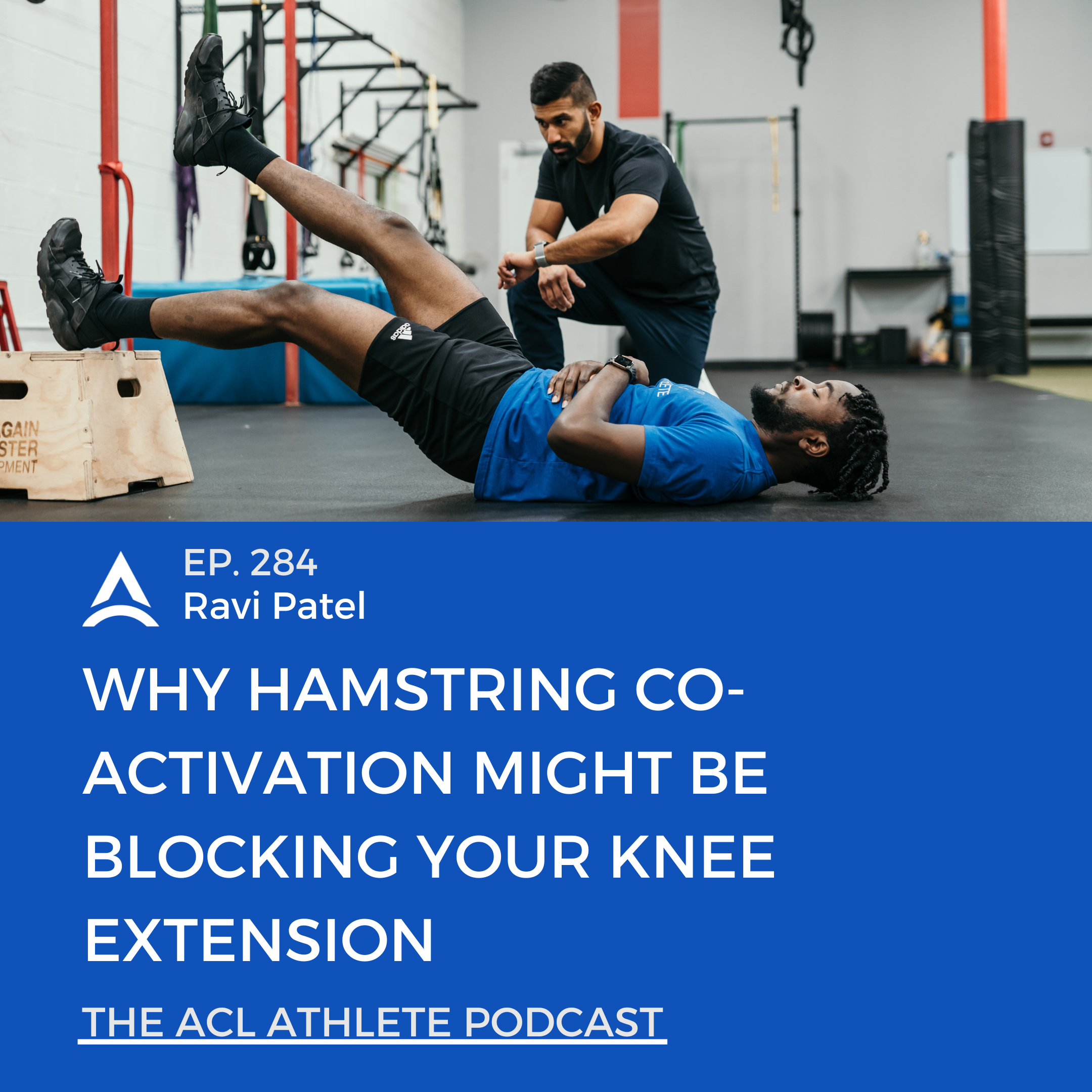
One simple way to look at this is with what we call the heel pop test. Lie down on a firm surface, not your bed and not a soft couch, because you want something where you can actually feel what is happening. From there, perform your quad set and see how much your heel lifts off the surface as you actively achieve knee extension.
Compare your involved side to your uninvolved side. What does your healthy side look like? How much extension do you have? How high does your heel come off the ground? Then compare that to your surgical side.
If they match, great. You probably do not need to spend much time worrying about this specific issue. But if there is a noticeable difference, that gives you useful information. It tells you there is still something limiting your ability to fully achieve that position.
Before we even talk about the hamstrings, I want to make sure you are already addressing the big rocks. Things like NMES, which we have talked about extensively in previous episodes, can help restore that connection between the brain and the quadriceps.
Using electrical stimulation, pain-modulating strategies like TENS, focal cooling, blood flow restriction training, isometrics at different angles, terminal knee extension work, and eccentric exercises when appropriate are all tools that can help improve quad function and reduce the effects of AMI.
But if you are doing those things and you are still stuck, this is where looking at the hamstrings may make sense. The goal here is not to strengthen the hamstrings. That is an important distinction. The goal is to fatigue them.
We are trying to reduce that protective overactivity and see if the nervous system is willing to ease off the brakes. Think about it like your hamstrings are acting like a security system that is a little too sensitive. They are trying to protect the knee, but sometimes we need to show your nervous system that it is safe to reduce that level of protection.
One simple option is a hamstring heel dig. You can do this lying on your back with your knee slightly bent. You can place something underneath your knee if that feels better, but it is not required.
The idea is simple: you are going to dig your heel down into the surface as if you are trying to scratch the floor or table underneath you. Your knee does not move. You are not trying to create a big movement. You are simply creating an isometric contraction of the hamstrings. Start with shorter holds, maybe 10 to 15 seconds, and gradually build toward 30, 45, or even 60-second holds depending on how your knee responds.
The goal is to create fatigue, not pain or irritation. You are simply trying to create enough work that the hamstrings begin to relax their protective role.
Another option is a single-leg hamstring bridge isometric hold. You can place your heels on a bench or elevated surface and lift your hips while keeping your knees bent. Then hold that position while focusing on the hamstrings working.
Again, we are not chasing maximum strength here. We are simply trying to create a controlled fatigue stimulus. A third option is changing the angle and working the hamstrings in a longer lever position.
For example, you can use a foam roller against a wall and place your feet on it while lying on your back. Then perform a bridge and hold that position. This challenges the hamstrings differently because the knee angle changes and you are working more through hip extension.
You can also incorporate the calves because they may contribute to knee flexion and that feeling of being stuck in extension. A hamstring-calf co-contraction variation can be another option where you intentionally fatigue both muscle groups.
But remember, you do not need every single variation. You are not trying to destroy your hamstrings or create a new training session. Pick one or two options, perform two to three rounds, and hold for 30 to 60 seconds.
Then reassess. Go back to your heel pop test. Check your knee extension. See if your quad activation feels different. Does your heel lift higher? Does your knee feel like it moves more freely? Does the quad feel like it can contribute a little more?
That test-and-retest approach is what tells you whether this strategy is actually useful for your situation. ACL rehab is a process of gathering information, adjusting, and finding what helps your individual body respond.
One other thing I want to mention is that after you work through something like this, it can be helpful to go right back into your extension work. This is where having a strap can be incredibly valuable.
And I want to emphasize this because I see people make this mistake all the time. Do not use a resistance band for this. A band is elastic, changes tension throughout the movement, and can make it harder to control exactly what you are trying to accomplish.
Instead, use something stiff and non-elastic, like a belt or yoga strap. The goal is to gently assist your heel upward while keeping the back of your knee pressed down into the surface.
You are allowing the knee to move into extension while giving your nervous system the opportunity to experience that position again. You are not forcing your knee straight. You are teaching your body that this position is safe.
And this is something we do not want to leave on the table, especially for athletes who are struggling with both quad activation and terminal knee extension. Those two things are connected.
Your quad cannot work efficiently if you never regain the ability to fully straighten your knee. And your knee cannot move normally if your nervous system continues to protectively limit that motion.
This is why ACL rehab is not just about strengthening muscles. It is about restoring movement, restoring confidence, and restoring the communication between your brain and your body.
If your quad will not wake up or you feel like you are constantly fighting those last few degrees of extension, remember that there may be more happening than just muscle weakness.
Your nervous system may be reducing the signal to your quadriceps while increasing protective activity from muscles like your hamstrings. And in certain situations, addressing that hamstring involvement may help you get more out of your quad activation work.
Again, this is not a magic solution. It is not going to be the answer for everyone. But if you feel like you have been doing everything else correctly and you are still stuck, this is one more tool you can consider adding to your process.
The great thing is that it does not have to be complicated. You may only spend a few minutes working through this. The goal is not to build stronger hamstrings. The goal is to create enough fatigue that your nervous system becomes a little less protective.
Then you reassess. Did your knee extension improve? Did your heel pop improve? Did your quad feel like it could contribute more? That information tells you whether this approach is useful for you.
Remember, ACL rehab is a process of testing, adjusting, and finding what works for your individual situation. What works incredibly well for one ACL athlete may not be the thing that moves the needle for another.
That is why working with a skilled physical therapist is so important. They can help you identify your specific limitations and determine how to address them appropriately.
So if you are an athlete listening to this and you are frustrated because your quad will not fire, or you feel like your knee extension is stuck, know that this is something many ACL athletes experience.
Keep working on the fundamentals. Keep addressing swelling. Keep improving your movement. Keep using strategies that help restore the connection between your brain and your quadriceps.
And if you feel like you have tried those things and you are still stuck, consider looking at the other side of the knee. The hamstrings may not be the problem, but they may be part of the conversation.
And if you are a physical therapist or coach listening to this, this is another potential layer to consider when you have an athlete who has been stuck in that early ACL rehab phase.
Sometimes the answer is not just pushing harder. Sometimes it is understanding what the nervous system is doing and finding ways to work with it.
At the end of the day, the goal is the same. We want to help ACL athletes have a more effective recovery process. We want to restore full knee extension, rebuild quadriceps strength, and help athletes feel confident moving forward toward the activities and sports they love.
I hope this was helpful. As always, I want to provide practical strategies, not just tell you there is a problem and leave you trying to figure it out on your own. If you need help, reach out to us. We are here to support you through this process. Until next time, this is your host, Ravi Patel, signing off.
Subscribe and leave The ACL Podcast a review – this helps us spread the word and continue to reach more ACLers, healthcare professionals, and more. The goal is to redefine ACL rehab and elevate the standard of care.
Resources:
- Check out our free ebooks on our Resources page
- Sign up for The ACL Athlete – VALUE Newsletter – an exclusive newsletter packed with value – ACL advice, go-to exercises, ACL research reviews, athlete wins, frameworks we use, mindset coaching, blog articles, podcast episodes, and pre-launch access to some exciting projects we have lined up
- 1-on-1 Remote ACL Coaching – Objective testing. An individualized game plan. Endless support and guidance. From anywhere in the world.
- More podcasts? Check out our archives
Connect: